Artificial Intelligence and Emerging Technologies
Artificial intelligence (AI) is increasingly shaping children’s online experiences. It powers search engines, chatbots, games, social media feeds and educational tools. AI can support learning and creativity, but it can also be misused.
This guide explains how AI can be misused and highlights the key safeguarding concerns that parents, carers and professionals should be aware of – including the growing use of AI to create abusive or sexualised images of children. These images can look very realistic, even though they are entirely fabricated, making it important for adults to understand the risks, help keep children safe and know how to respond if something goes wrong.
What is AI?
AI refers to computer systems designed to carry out tasks that normally require human intelligence, such as solving problems, making decisions or predicting information.
Generative AI is a type of AI that can create new content, including text, images, video and audio. Common examples include ChatGPT, Microsoft Copilot, and Meta AI.
Image and video-based AI tools can also generate highly realistic images or deepfake videos. A deepfake is an image, video, voice recording or sound clip that has been digitally altered to make it appear as though someone has done or said something they have not. This can be created with or without their consent.
What Is AI generated child sexual abuse material?
AI generated child sexual abuse material (AI CSAM) refers to images or videos created or altered using AI to make it appear as though a child is involved in a sexual or abusive situation.
This can include:
- digitally ‘nudifying’ or removing clothing from an innocent photo
- creating entirely fabricated images that look real
- using deepfakes to place a child’s face onto another body
- manipulating photos taken from social media or other platforms
Why might young people misuse AI to create nude imagery?
Some children and young people may misuse AI to create nude or sexualised images of others. Their reasons can include:
- thinking it is a joke or “banter”
- pressure from friends or group chats
- bullying or trying to embarrass someone
- arguments or revenge
- curiosity about new technology
Is It Illegal?
Yes. Under the Protection of Children (Northern Ireland) Order 1978, it is illegal to take, possess or share nude or sexual images of anyone under 18 – including images created using AI. It is important that young people are aware of this.
The law exists to protect children from abuse and exploitation, not to criminalise them.
What should I do if AI is used to create harmful images of my child?
If your child tells you that someone has created, edited or shared harmful AI generated images of them, or is threatening to do so, it is important to act quickly, calmly and supportively.
Report what has happened
If you believe the content is harmful or illegal (for example, AI‑generated child sexual abuse material), report it to the police on 101 or online, and in the case of an emergency 999.
You can also report concerns to CEOP and the Internet Watch Foundation.
If the incident involves other young people at your child’s school or club, contact the Designated Teacher or Safeguarding Lead so they can help investigate and provide further support.
Reporting early helps protect your child and allows professionals to act quickly.
Stay calm and reassure your child
Let your child know you are glad they told you. Remind them:
- it is never their fault
- they are not to blame
- they are not in trouble
- they are not alone, you will deal with this together
Report to the site, app or platform
Always report illegal or harmful content on the platform where it appears. Do not share it and consider blocking the user who posted it.
The Report Harmful Content website operated by SWGfL provides step-by-step guides for reporting issues on popular social networks and video platforms.
Avoid deleting anything
Keep messages, screenshots, usernames, links and images. This information can help identify the person responsible. Encourage your child not to delete anything until the incident has been reported and professionals advise otherwise.
If the images are saved on your child’s device, they can use Report Remove, a free service for under 18s to remove or prevent the sharing of nude, partially nude or sexual images of themselves – including AI generated images.
Seek further advice and support
Experiences online can have a real impact on your child’s wellbeing. Being targeted in this way may affect their mental health, confidence and school life. Getting the right support for your child and your family is important.
The following services can help:
- NSPCC Helpline: (0808 800 5000) free, confidential advice and guidance for parents, carers and families who are worried about a child or unsure what to do next.
- Parentline NI (0808 8020 400) offers free and confidential support and advice to parents and carers.
- Childline: (0800 1111) for u19s who prefer to talk directly to a counsellor.
- Your GP is also an important source of support if you are concerned about your child’s health or wellbeing.
- Lifeline: (0808 808 8000) free, 24-hour crisis response helpline for anyone in distress.
- Minding Your Head: mental health information and support for young people and adults.
What should I do if my child has created or shared harmful AI generated images?
Stay calm and reassure your child
If you discover that your child has created or shared harmful or illegal AI‑generated images, try to stay calm. It may be distressing, but your child needs your support.
Many young people experiment with technology without understanding the seriousness of their actions. Talk to your child in a calm, non‑judgemental way and ask what happened. Reassure them you are there to help, while making it clear that creating or sharing harmful images is never acceptable and can cause real distress.
Inform your school or relevant authorities
Think about the wellbeing of everyone involved. Support your child, but ensure any other child affected is protected from further harm and upset.
If another child is involved, contact their school, youth group or club, and speak to the Designated Teacher or Safeguarding Lead for advice.
If any child is at risk of harm, contact the police on 101 or online, and in the case of an emergency 999.
Remove and delete the harmful content
Sit with your child and delete the material from their phone, apps, cloud storage and any platforms where it may have been shared.
Do not save, forward or show the image to anyone else.
Report the content on every platform where it was posted
Even if the image has already been deleted, reporting it helps platforms detect and remove copies.
Encourage your child to work with you to make a report on each platform where the image was created, uploaded or shared.
The Report Harmful Content website provides clear step-by-step reporting guides.
Explain that this step helps reduce the risk of the image spreading further.
Seek advice and support
You do not have to manage this alone.
If you need guidance or emotional support, contact the NSPCC Helpline on 0808 800 5000 or email [email protected]. A child protection specialist will listen, talk through your concerns and guide you through safe next steps.
More information on who to contact if you are worried about your child’s wellbeing can be found in the section above.
Top tips for talking to your child
Start conversations early
Have frequent, open and non-judgemental conversations with your child about where they are seeing AI tools and content online. Remind them:
- not everything online is real
- many images and videos are edited or created using AI
- it is never acceptable for anyone to create content that harms or targets another person
Use these conversations to explore both the risks and benefits they’re experiencing.
Review privacy settings and parental controls
Talk to your child about why privacy settings matter and how they help restrict who can contact them, view their content or interact with them online.
Internet Matters provides step by step guides to help you set up parental controls, adjust privacy settings, and limit what others can see across the devices, apps and platforms your child uses – including Apple, Google/Android, PlayStation, Xbox, Roblox, Snapchat, TikTok, YouTube and many more.
Reviewing settings regularly with your child helps ensure they still have the right level of protection.
Make sure they know where to go for support
Let your child know they can always come to you with any concerns and that they won’t be judged.
If they feel unable to talk to you, help them identify other trusted adults or sources of support, such as Childline.
Children and young people can use the Report Remove tool to report AI generated child sexual abuse material that has been shared, or may be shared online.
The reporting pathways tool signposts to other agencies who can help.
Guidance for professionals working with children and young people
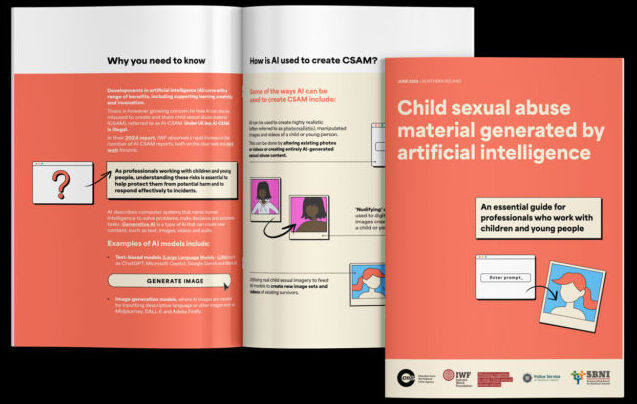
The Internet Watch Foundation, NCA CEOP and the SBNI have jointly produced professional guidance on AI generated child sexual abuse material. This resource helps professionals understand the risks and respond effectively.
Educational resources for schools, colleges and youth settings
Helping children and young people understand AI, use it safely and recognise potential risks begins with strong preventative education.
Teaching them how AI works, how it shapes online content and how it may be misused gives them the confidence and skills to make safer choices.
Available educational materials include:
- A range of free educational resources is available to support schools, colleges and youth settings in delivering lessons on the broader issues of AI. The UK Safer Internet Centre provides ready‑to‑use materials for ages 3–7, 7–11 and 14–18, available in English and Irish. These education resources include classroom activities, presentation slides and whole‑school assemblies to help educators explore topics such as how AI shapes online content, how it is used in everyday life and how it can be misused, including to create non‑consensual nude images. They are designed to help build digital literacy and encourage safe and responsible use of AI.
- Childnet has also created educational resources to help education and youth settings address AI misuse and nudification. The pack includes three lesson plans with teacher guidance and an information leaflet for parents and carers. The lessons, designed for ages 13–17 (with options to adapt for 11–12‑year‑olds), explain what generative AI is, how it can be misused to create nude or sexualised images, and how to report harmful content. Each lesson comes with slides and supporting materials, and the parent leaflet provides clear explanations, conversation starters and advice on where to seek further help.