
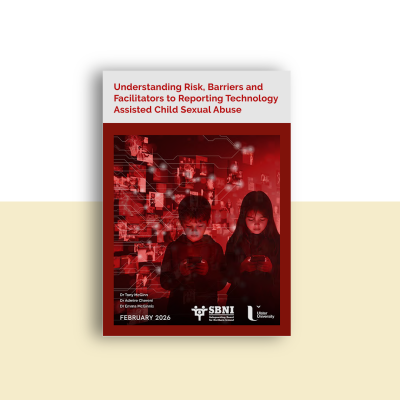
A new report by Ulster University, commissioned by the Safeguarding Board for Northern Ireland (SBNI) under the NI Executive’s Online Safety Strategy, brings together evidence from more than 70 research studies to better understand:
- Which children are most at risk of technology assisted child sexual abuse (TACSA)?
- Why so few victims disclose?
- What helps children and young people feel able to tell someone and seek help?
The research was carried out by Dr Tony McGinn, Dr Admire Chereni and Dr Emma McGinnis at Ulster University.
Key Findings
The Scale of the Problem
500,000
estimated children experience TACSA in the UK each year
(National Police Chief’s Council, 2025)
Yet only a very small proportion ever come forward.
The Alexander McCartney case, in which a Northern Irish offender abused around 3,500 children worldwide, demonstrates the severity and far reaching harm caused by this form of abuse.
Who is most at risk?
All children can be targeted, but some are more vulnerable:
- Prior victimisation: Children who have already experienced bullying, neglect, or other abuse
- Isolation and loneliness: Young people seeking connection online
- Low self-esteem or depression:Mental health difficulties increase vulnerability
- LGBTQIA+ young people: Particularly when exploring identity online
- Children in care or known to services: Higher rates of online victimisation
- Weakened parent–child connection: Less monitoring and support increases risk
Why children don’t disclose
The report highlights several strong barriers:
- Shame and self-blame
- Fear of consequences (e.g., devices being confiscated, images being shared)
- Not recognising abuse
- Grooming and manipulation
- Generational disconnect (fear adults won’t understand or will overreact)
What helps children disclose
Children are more likely to come forward when:
- They have trusted, non-judgemental adults in their lives
- Peer support is available
- They understand what TACSA is
- Professionals ask directly and sensitively about online experiences
The primary recommendation
Hold online platforms to account
While education is important, the report finds that education alone has not significantly reduced vulnerability.
The report emphasises the need to:
- Ensure online platforms cannot be used by predators to anonymously target children
- Fully implement and enforce the Online Safety Act 2023
- Introduce meaningful identity verification to prevent anonymous adult to child contact
At present, offenders can:
- Create fake profiles posing as children
- Contact large numbers of potential victims with minimal risk
- Groom children through end to end encrypted channels
Implications for practice
Professionals should:
- Recognise TACSA as equally harmful as offline abuse
- Understand and assess heightened vulnerability
- Ask directly about online experiences
- Expect non disclosure as the norm
- Build trusting relationships where children feel safe to share
For enquiries relating to this research contact:
Dr Tony McGinn
Ulster University, Magee Campus
© Copyright Ulster University 2026